Drought Resistant Landscaping Plans for Santa Ana CA Families
Santa Ana families do not need a lecture on dry weather. They live with it. Lawns turn brittle fast, water bills climb when summer settles in, and a yard that looked lush in April can start struggling by late June if it was designed for a different climate. That is why drought resistant landscaping is not a passing trend in Orange County. It is a practical response to heat, water limits, maintenance costs, and the way people actually use their homes.
A good plan does more than replace grass with gravel and call it done. It should cool the property where possible, keep maintenance reasonable, give children and pets usable space, and still make the house feel welcoming from the street. It also needs to survive the local pattern of long dry stretches interrupted by periods of intense rain. In Santa Ana, that combination matters. A yard has to handle drought, but it also has to manage runoff, avoid erosion, and stand up to heat reflected from pavement, block walls, and stucco.
Families often start this process because the old yard has become expensive and frustrating. The sprinklers need constant repair. The front lawn has bare patches. The slope near the driveway sheds water too fast. Plants burn on the south side of the house. Sometimes the deeper issue is that the original landscape never matched the way the family lives. If no one plays on the lawn, watering it starts to feel wasteful. If weekends are packed with sports and errands, pruning thirsty shrubs every few days is not realistic.
The best drought resistant landscaping plans begin with honest questions. Where does the family spend time outside? How much maintenance can they truly keep up with? Which parts of the yard need shade, privacy, or open room? Which views matter from the kitchen window and from the street? Once those answers are clear, the design decisions get much easier.
What drought resistance really looks like in a family yard
Many people picture a drought-tolerant yard as stark, rocky, and sparse. That image comes from rushed conversions that remove lawn without replacing comfort or structure. A well-designed drought resistant yard in Santa Ana should feel intentional. It should have landscaping resources layers, usable pathways, durable surfaces, and planting that looks landscaping service in santa ana settled into the site rather than scattered across it.
In practice, that usually means reducing high-water turf to only the areas where it earns its keep. A small patch for children to play, a dog run, or a soft seating area can make sense. A broad decorative lawn in full sun often does not. The water use is high, the upkeep is constant, and the visual payoff is limited once the grass starts thinning at the edges.
The next step is shaping the yard around climate-appropriate planting. That does not mean every plant has to be native, though California natives can work beautifully. It means selecting plants that tolerate heat, lean irrigation, reflected glare, and local soils, then grouping them by water need. One of the costliest mistakes I see is mixing thirstier ornamentals with low-water plants on the same irrigation valve. The result is predictable. Something is either overwatered, underwatered, or both, depending on the season.
Hardscaping plays a much bigger role than many homeowners expect. Patios, decomposed granite paths, permeable pavers, seat walls, boulders, and gravel bands all reduce irrigation demand while making the yard easier to use. Hardscaping also gives the design a backbone. Without it, a drought-tolerant planting scheme can feel unfinished, especially in the front yard where curb appeal matters.
Why Santa Ana properties need a local approach
A drought plan that works near the coast may not perform the same way inland. Santa Ana can run hotter, with more intense afternoon sun and drying winds that stress new plantings quickly. Even a modest difference in microclimate can change how often young plants need water during establishment.
That matters most in front yard landscaping because the exposure is often harsher than people realize. The front yard usually gets full sun, reflected heat from the street, and less daily attention than the backyard. Homeowners often spend money on attractive plants, then lose them because the design did not account for afternoon heat load, limited shade, and overspray from nearby pavement.
Family life adds another layer. A front yard cannot be so delicate that children are told not to step into it. It should tolerate guests arriving, delivery drivers cutting a corner, and the occasional soccer ball. A backyard needs room for dining, circulation, and storage, not just a pretty planting bed around the fence line. When those practical needs are built into the plan from the start, the finished yard feels calm instead of fussy.
The smartest place to start is layout, not plants
Most homeowners begin by shopping for plants. Professionals usually begin with layout. That order matters because plant choices make more sense after circulation, gathering areas, drainage, and focal points are resolved.
If a family wants a shady place to sit after work, the patio and tree placement should come first. If there is a side yard that bakes in the sun and never gets used, it may be better suited to utility functions, storage, or a low-water path rather than a planting-heavy feature. If the front yard has a long blank stretch between the driveway and entry walk, that is an opportunity to use hardscaping and massed planting to create rhythm and reduce maintenance.

The layout stage is also where budget discipline helps. A plan can be phased, but it should still be designed as one whole composition. I have seen many partial renovations where the homeowner replaced lawn with gravel in year one, added plants in year two, and built a walkway later. The result usually looks pieced together because no one established the final layout from the beginning. A master plan, even for a phased project, prevents that problem.
Front yard landscaping that saves water and still looks finished
Front yard landscaping sets the tone for the house. On many Santa Ana streets, the front yard is also the most visible part of the property, so homeowners understandably worry that low-water design will look bare. It does not have to.
The most successful front yards usually combine a clear path to the entry, a strong material palette, and plant groupings that read as intentional masses rather than isolated specimens. Repetition does a lot of the visual work. Instead of buying one of everything at the nursery, it is usually better to choose fewer varieties and use them well. Repeated grasses, succulents, or flowering shrubs create coherence and are easier to maintain than a collector-style garden.
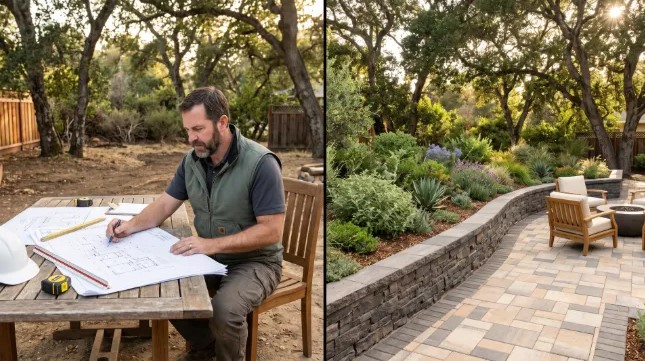
A simple example works well on many Santa Ana lots. Replace most of the front lawn with a permeable decomposed granite field or gravel mulch, anchor the space with a small drought-tolerant tree, then build depth with medium-height shrubs and groundcovers. Add a widened entry path, a few accent boulders, and low-voltage lighting. The water use drops sharply, yet the yard still feels welcoming and complete.
There are trade-offs, of course. Gravel-heavy designs can throw heat if overused in full sun. Some succulents look sculptural but may not give enough softness near an entry. Certain low-water plants attract bees, which is not a flaw, but it is worth considering around play areas or narrow walkways. Good design is partly the art of placing the right plant in the right social setting, not just the right climate zone.
The role of hardscaping in drought resistant landscaping
Hardscaping is often where a drought plan shifts from merely efficient to genuinely livable. A family yard needs places to walk, sit, gather, and store things. Every square foot that serves a purpose through durable surfaces is a square foot that does not need irrigation.
That does not mean paving everything. Too much hard surface can increase heat and runoff if materials are chosen poorly. The goal is balance. Permeable pavers can support a seating area while allowing some infiltration. Decomposed granite gives a softer, less formal path. Mulched planting beds buffer heat better than bare stone. Seat walls can replace bulky patio furniture in tight spaces and make a small yard feel more open.
In one Orange County project with a modest backyard, the family initially wanted to preserve a large rectangular lawn for occasional parties. After measuring the space and discussing how they really used it, they reduced the turf to a small central panel and expanded the patio by several feet. That change made room for outdoor dining, a grill station, and a path wide enough for kids to loop around on scooters. Water demand dropped, and the yard actually became more useful. That is a common pattern. When outdoor spaces are designed around behavior instead of habit, families rarely miss the extra lawn.
Plant choices that tend to perform well
Plant selection should never be copied blindly from a photo. Sun exposure, soil drainage, slope, and irrigation method all matter. Still, some plant types repeatedly prove their value in Santa Ana when used thoughtfully.
Here are five categories that often earn their place in a drought-tolerant family landscape:
- Small shade trees that handle heat and provide canopy without overpowering the lot
- Structural shrubs that keep form with limited water and do not need constant shearing
- Ornamental grasses or grass-like plants that soften hardscaping and move well in the wind
- Groundcovers that knit soil together and reduce the amount of exposed mulch or gravel
- Accent succulents or architectural plants used sparingly to create focal points
The key phrase is used thoughtfully. Even durable plants can fail in the wrong spot. A low-water shrub planted against a west-facing wall may need more support than the same plant placed with morning sun and afternoon relief. New installations also need more water in the first season than mature landscapes. hardscaping santa ana Drought tolerant does not mean drought proof on day one.
Irrigation is where many good designs fall apart
A yard can be beautifully planned and still underperform if the irrigation is sloppy. Overspray onto sidewalks, mixed emitter types, poor pressure control, and valves that water unlike plants together are some of the most common issues. These are not glamorous details, but they decide whether the landscape thrives.
For most drought resistant landscaping plans, drip irrigation or point-source emitters make sense in planted areas, while any remaining lawn should be zoned separately. Smart controllers can help, especially when adjusted seasonally, but they are not magic. They still need programming that fits the site. A controller cannot compensate for a bad layout, clogged landscaping santa ana emitters, or a planting bed that mixes very different water needs.
Families should also think beyond pure efficiency. Irrigation systems need to be understandable. If one parent knows how to adjust it and the other does not, or if a simple repair requires a specialist every time, the system becomes a headache. Straightforward zoning, labeled valves, and accessible parts save a lot of frustration later.
Custom Landscaping ideas for real family routines
Custom Landscaping ideas work best when they respond to daily life rather than abstract style. A family with young children needs durability and sightlines. A household with teenagers may want a larger social patio and lower-maintenance planting. Grandparents visiting often may need smoother paths and fewer elevation changes.
Some of the most effective custom moves are not flashy. A bench tucked near the front entry gives parents a place to wait during school pickup. A widened side yard can store bikes neatly instead of turning the backyard into a clutter zone. A dry creek feature can direct runoff from a downspout while adding character to the front yard. A narrow planting strip along a fence can be redesigned with cleaner masses and drip irrigation so it stops being the problem area everyone ignores.
For bilingual or multigenerational households, outdoor spaces often carry more daily activity than designers assume. Cooking, visiting, supervising children, and casual evening sitting may all happen outside. That is one reason I favor plans that combine planted zones with practical surfaces rather than pushing everything into beds. The yard should support the family without asking them to constantly protect it from ordinary use.
Budget choices that make the biggest difference
Not every project needs a full overhaul. Some of the best results come from directing money to the changes that affect water use and function the most. Families often get better value from fixing layout and irrigation than from buying larger specimen plants.
If the budget is limited, these upgrades usually return the most benefit:
- Remove the least useful turf first, especially decorative lawn in harsh sun
- Install or correct irrigation zones before adding large amounts of planting
- Build the main paths and patio areas early so traffic patterns stop damaging beds
- Choose fewer plant varieties and repeat them instead of buying many one-off accents
- Spend on soil preparation and mulch where needed, because establishment depends on it
There is also the issue of phasing. If a family cannot do the entire property at once, the front yard often delivers the quickest visible improvement, especially when the old lawn is the largest water user. On the other hand, if the backyard is where the family actually spends time, it may deserve priority even if it is less visible from the street. There is no universal answer. The right phase plan reflects where the pain points are strongest.
Common mistakes that cost Santa Ana homeowners money
The first mistake is overcommitting to decorative stone. A little gravel or rock mulch can be useful, but a yard dominated by reflective stone often feels hotter and less welcoming, especially in summer. It may reduce watering, but it can also increase discomfort and make the home feel visually harsh.
The second is choosing plants based on the nursery tag photo rather than mature size and site conditions. That is how shrubs end up blocking walks or crowding windows within two years. Then they get hacked back repeatedly, which raises maintenance and weakens the design.
The third is assuming low-water means no maintenance. Every landscape needs care. Mulch has to be refreshed. Drip lines need inspection. Trees need formative pruning. Weeds definitely do not disappear just because the lawn is gone. The good news is that the maintenance tends to be more predictable and less water-intensive than with conventional thirsty landscapes.
The fourth is ignoring drainage. Santa Ana may be dry much of the year, but when heavy rain comes, poorly graded yards show every flaw at once. Water pools at the patio edge, runs toward the garage, or cuts channels through loose mulch. A drought plan still has to manage stormwater sensibly.
What a finished yard should feel like
When a drought-tolerant landscape is done well, the first thing most families notice is not the lower water use, though that matters. They notice relief. The yard feels easier. The house looks cleaner from the street. Weekends are not consumed by sprinkler repairs and dead patches. The outdoor spaces get used more because they were designed for actual life, not for an old idea of what a Southern California yard should look like.
That result comes from restraint and judgment. Not every square foot needs planting. Not every plant needs to bloom. Not every family needs turf. The best plans edit aggressively, then build back beauty through texture, proportion, shade, and smart hardscaping.
For Santa Ana CA families, drought resistant landscaping is less about sacrifice than alignment. The climate asks for a certain kind of honesty. A yard should respect water, handle heat, and still feel generous. With the right layout, sensible irrigation, durable materials, and planting that fits the site, it can do all of that while giving the family something many older landscapes never quite delivered: a yard that looks good, works hard, and stays manageable season after season.